


What Is Clustered Hosting? Benefits, Types, and How It Works
Most websites start on a single server. That works well until traffic grows, the server needs maintenance, or hardware fails. When a website cannot afford to go offline, many businesses look at clustered hosting.
In this guide, we explain what clustered hosting is, how it works, its main types, its benefits and drawbacks, and who actually needs it.
What Is Clustered Hosting?
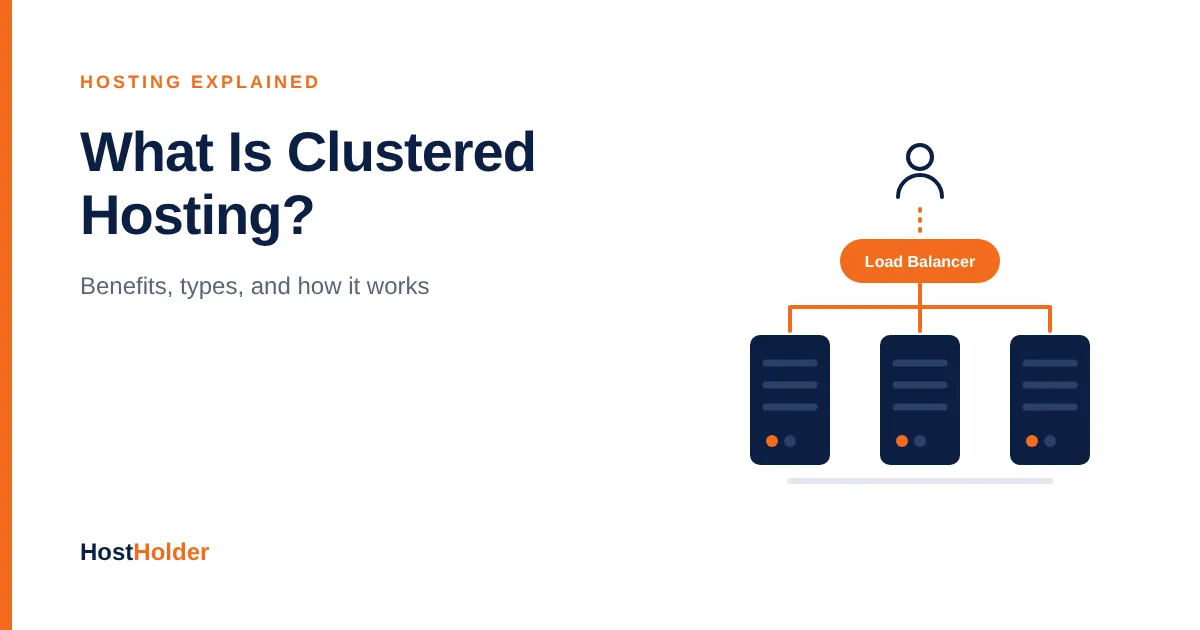
Clustered hosting is a setup in which a group of connected servers works together to run your website or application. Instead of depending on one machine, your site is served by several servers, called nodes, which share the workload.
To visitors, the cluster looks like a single website. Behind the scenes, multiple servers handle requests, store data, and take over from each other when something goes wrong.
How Does Clustered Hosting Work?
A typical hosting cluster has a few key parts:
Load balancer: Receives incoming visitor requests and distributes them across the available servers.
Web server nodes: Several servers that run the website code and respond to visitors.
Database servers: One or more servers that store and manage website data, often replicated so data exists on more than one machine.
Shared or replicated storage: Keeps website files consistent across all nodes, so every server delivers the same content.
Health monitoring: Constantly checks each node. If one stops responding, traffic is automatically sent to the healthy nodes.
For example, when 1,000 visitors arrive at the same time, the load balancer might send some to Server A, some to Server B, and the rest to Server C. If Server B fails, the load balancer stops sending visitors there, and the website stays online.
Types of Clustered Hosting
Hosting clusters are usually grouped by the job they are designed to do. Many real-world setups combine more than one type.
1. Load-Balanced Clusters
Traffic is spread across multiple web servers so no single server is overwhelmed. This improves speed and allows the site to handle traffic spikes.
2. High-Availability (Failover) Clusters
These clusters focus on keeping services online. A standby server is ready to take over automatically if the active server fails, which minimizes downtime.
3. Database Clusters
The database is replicated across several servers. This protects data, improves read performance, and allows the database to keep running if one database server goes down.
4. Storage Clusters
Files are stored across several machines, so data stays available even if a disk or storage server fails.
Benefits of Clustered Hosting
1. Higher Uptime
The biggest advantage of clustering is reliability. Because there is no single point of failure, one server going down does not take the entire website offline.
2. Better Performance Under Heavy Traffic
Load balancing spreads requests across multiple servers, which helps the website stay fast during busy periods, sales campaigns, or sudden traffic surges.
3. Easy Scalability
When traffic grows, you can add more nodes to the cluster instead of moving the entire website to a bigger server.
4. Maintenance Without Downtime
Servers can be updated or repaired one at a time while the other nodes continue serving visitors.
5. Improved Data Protection
With replicated databases and storage, your data exists in more than one place, which reduces the risk of data loss from a single hardware failure.
Drawbacks of Clustered Hosting
Clustered hosting is powerful, but it is not the right choice for every website.
Higher cost: Running several servers costs more than a single hosting account.
More complexity: Clusters require careful setup, synchronization, and monitoring.
Application compatibility: Some applications need adjustments to work properly across multiple servers, especially for sessions, caching, and file uploads.
Overkill for small sites: A blog, portfolio, or small business website rarely needs a cluster.
Clustered Hosting vs Shared Hosting
Feature | Shared Hosting | Clustered Hosting |
|---|---|---|
Servers | One server shared by many websites | Multiple servers working together |
Single point of failure | Yes | Reduced or removed |
Traffic capacity | Suitable for small to medium sites | Built for high or unpredictable traffic |
Scalability | Upgrade to a higher plan | Add more nodes |
Cost | Most affordable | Higher |
Best for | Blogs, portfolios, small businesses | Large stores, high-traffic platforms, critical applications |
Who Needs Clustered Hosting?
Clustered hosting makes sense for:
Large e-commerce stores where every minute of downtime means lost sales
News portals and media websites with sudden traffic spikes
SaaS applications and online platforms with many active users
Businesses with strict uptime requirements
For most blogs, portfolios, startups, and small business websites, a well-managed shared hosting plan provides more than enough performance at a much lower cost. You can move to a more advanced setup as your traffic grows.
Choose the Right Hosting for Your Website
The best hosting is the one that fits your website’s current needs and budget. If you are starting a new website or running a growing small business, reliable shared hosting is usually the smartest first step.
HostHolder offers affordable, secure hosting with NVMe storage, free SSL, and local support for Bangladeshi businesses, freelancers, and bloggers.
👉 Explore hosting plans at HostHolder
Frequently Asked Questions (FAQs)
1. What is clustered hosting in simple words?
Clustered hosting is when several servers work together as a team to run a website, so the site stays fast and online even if one server has a problem.
2. Is clustered hosting the same as cloud hosting?
Not exactly. Cloud hosting usually uses clustered infrastructure behind the scenes, but cloud hosting also includes features like on-demand resources and virtualization. Clustering is the underlying technique; cloud hosting is a broader service model.
3. Does clustered hosting guarantee 100% uptime?
No hosting can guarantee absolute 100% uptime. Clustering greatly reduces downtime from hardware failures, but network, software, or configuration issues can still cause interruptions.
4. Is clustered hosting good for WordPress?
Yes, for large and high-traffic WordPress sites. It requires proper setup for shared files, caching, and database replication. Most small WordPress sites do not need it.
5. Is clustered hosting expensive?
It costs more than shared hosting because it uses multiple servers and more complex management. The cost is usually justified only for websites where downtime is very costly.
6. When should I upgrade to clustered hosting?
Consider it when your website regularly receives high traffic, a single server can no longer handle the load, or downtime directly affects your revenue.
Final Thoughts
Clustered hosting connects multiple servers so they work as one, delivering higher uptime, better performance under heavy traffic, and easier scalability. It is an excellent solution for large and business-critical websites.
For most growing websites, however, reliable shared hosting is the right place to start. Choose hosting that matches your needs today, and upgrade when your traffic demands it.
Looking for reliable hosting for your website? Visit HostHolder.com to find the right plan.